
It’s a reasonable question to ask about cladding durability: How long does cladding last? Unfortunately, this is a bit like asking “How long is a piece of string?”
By “cladding”, we refer to the material attached to the exterior (or interior) of a building’s walls that protects the internal structure from weather and the elements, provides a level of insulation against temperature extremes, as well as noise, and serves an aesthetic function when used decoratively. Your options include traditional timber, plywood, metal, PVC, fibre cement, plaster, vinyl, brick, stone-look cladding or a composite cladding.
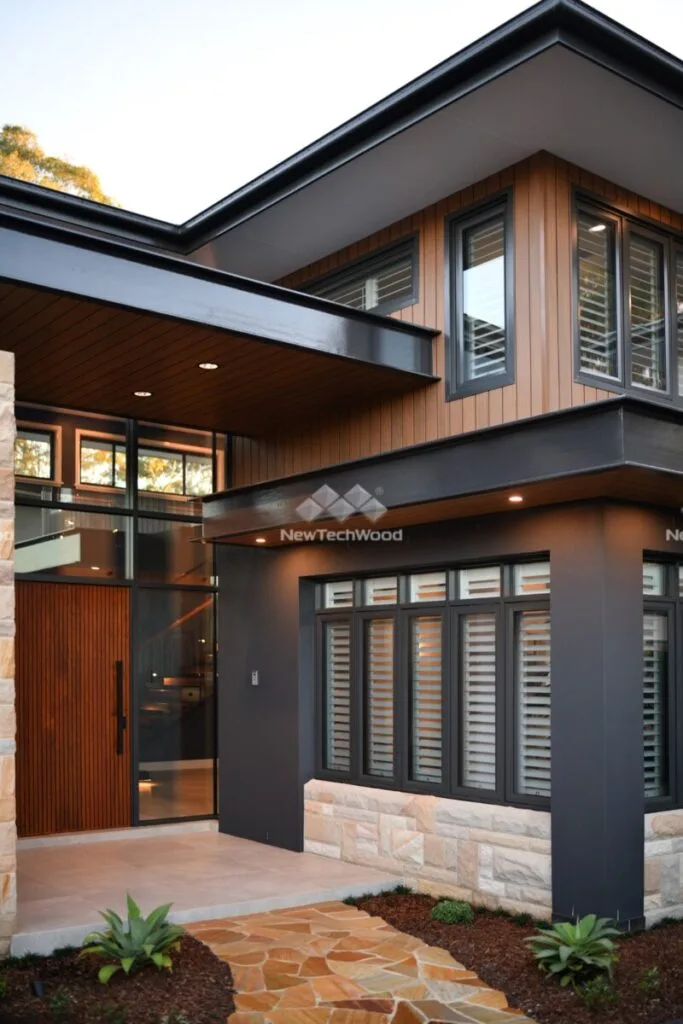
(Image: Binet Homes, NSW, featuring NewTechWood US31 in Teak)
Factors Affecting The Durability of Cladding
You want cladding and decking that goes the distance, as well as looking good. Several factors determine how long your cladding should last and which type of cladding might be your best option. Metal, plastic, timber and composite claddings all have their pro’s and con’s.
While your kids and critters might have some impact on your deck’s wear and tear, its lifetime really comes down the climate it’s exposed to (hello, harsh Australian sun), the levels of maintenance you lavish upon it, and the effect of termites and other pests (not the ones you live with).
Climate
Is your house blasted by the scorching sun, or sitting next to the salty ocean? Some cladding materials are best suited to particular climatic conditions, so if you install a product that’s better suited to a cooler climate and you live in the tropics, it stands to reason that it may not last as long.
Harsh weather, especially a relentless mix of UV rays, wind, rain, and salty air in coastal areas, will quickly break down materials that aren’t specifically designed to handle those conditions. Metal and untreated wood are particularly vulnerable.
The material quality itself is critical. A naturally durable timber or a high-grade composite will resist issues like rot, rust, or fading much better than cheap cladding materials.

Level of maintenance & care
Even the best cladding needs to be installed properly; inadequate sealing creates weak spots where moisture can creep in, causing rot and mold behind the panels and eventually compromising the whole system and leading to expensive repairs down the line.
When it comes to maintenance, some types of cladding, like natural timber, will need more care and attention than cladding like metal or composite, which is better able to look after itself.
Termites and Other Pests
Termites affect different cladding materials based on whether they think it tastes good. This makes wood extremely vulnerable to termites and other pests. Untreated older types of wood composite can be vulnerable, while termites tend to leave modern treated composite and metal well alone.
It’s not just timber that can suffer from pests. Even if you decide to go with a timber-look composite, while that won’t attract termites, some cheaper brands of composite cladding with unprotected foam backing can house rats, mice and birds.
NewTechWood is fully protected on all 4 sides of the board, so it is impossible for pests to make a home there. The only other cladding material that can confidently boast that protection is metal.
Metal cladding durability and lifespan
Metal cladding is a popular choice for modern home designs, although it’s less popular for decks because it’s hot and hard on the feet.
A long-term option
Metal’s a good long-term option because it’s a low maintenance cladding, versatile and durable, as well as putting pests off. It’s also good at withstanding lots of extreme weather conditions and suits a modern, sleek aesthetic. But, as a natural conductor, metal cladding can be a mismatch for the Australian climate.
Not suitable for coastal living or warm environments
Metal cladding is generally less suited for coastal living and warm environments because salt from the spray corrodes it and makes it look rusty, while extremely hot temperatures can put stress on the panels.
This means the metal can warp, fade or start rattling. From a safety perspective, the heat can also loosen fasteners and compromise the sealants.
How long does timber cladding last?
Timber cladding definitely has the ability to be in it for the long haul, depending on the quality. High quality, properly installed durable timber cladding can last between 40 and 60 years, but it does require a lot of maintenance. All too often, with timber cladding, whether you stain it or paint it, within a few years, that stain and paint will start to fade, chip, and peel away. Depending on the timber used, you may also need to have it treated with termite protection throughout its lifetime.
Once the sealant and treatment start to age, as it does sooner rather than later in our extreme Australian climate, the timber boards lose their protection and start to disintegrate.
Medium durability, high upkeep
Get ready to roll your sleeves; timber cladding requires regular washing with a soft brush and a low pressure hose. You can use a mild detergent to get rid of salt deposits. If you find mildew or mould, you need to treat it with a fungicidal wash or diluted bleach.
You’ll also need to keep an eye out for vegetation and weeds.
While timber can be a durable cladding, it’s high maintenance because you will need to recoat it. If you want to keep it looking fresh, you’ll need to recoat it with either oil or paint every 1-5 years, depending on the quality of the timber.
Composite wood cladding: a low-maintenance alternative?
Composite is one of the most popular cladding systems because it’s perfectly suited for Australian temperatures, doesn’t require regular, ongoing maintenance like natural timber but does still have aesthetic appeal. It also offers fire resistance. But not all composites offer the same level of quality.
Composite cladding products can give you the look and feel of maintenance free timber cladding, without the associated recoating and maintenance expenses.
No sanding, sealing or painting required
Some composite cladding, like NewTechWood, is a pre-finished product, which means there is no need to even think about stains or paints – you just choose your colour, and that’s it.
High-quality composites, like NewTechWood, are fully protected by a capping made from a special engineering-grade polymer and additives with extremely low water penetration. Using a co-extrusion process, the shield is heat pressed onto the core, creating an impermeable protection coating against moisture, ultra-violet (UV), insects and bacteria.
For you, this means saving time and money, and if you are a NewTechWood owner, you have the peace of mind of a 25-year warranty.
In addition, NewTechWood cladding is eco-friendly, offering a much lower carbon footprint and better energy efficiency than other options, like fibre cement cladding for example. This makes our cladding a durable, guilt-free option that is the ideal choice for Australian homes.
Are all non-natural timber cladding products maintenance-free?
Unfortunately, no. Some pure plastic cladding and some types of fibre cement are more prone to damage and the elements than others. It’s advisable to use a suitable product to protect heat-treated or thermally modified natural timbers from the damaging effects of exposure to UV radiation.
We can reassure you that fully capped composite cladding, like NewTechWood, is a fully finished product that requires no sealing, oiling, staining or painting over its lifetime. It has unrivalled durability and has stain and UV protection.
It is also of no interest to termites or other wood-boring pests. NewTechWood is made of 95% recycled materials, so it is environmentally friendly. In short, this timber-look cladding will stand up to all weather conditions, sun or snow, without requiring maintenance from you.

Image Credit: Keksia.
How do lifetime costs compare?
In the short term, NewTechWood is likely to cost more than a traditional timber or metal cladding solution. But when you compare the maintenance, material, time and labour cost on traditional timber decks every year the costs really add up.
With composite cladding, what you pay upfront is all you ever pay. In less than three years, you will be able to see all the time and money you would have saved by using NewTechWood composite timber.
Ready to get started? Find your local NewTechWood cladding retailer.