
When designing a modern outdoor entertaining space, choosing between natural timber and modern composites are one of the most critical decisions an Australian homeowner can make. Do you stick with traditional timber, or take a leap forward and opt for the increasingly popular composite timber decking? Here we explore the pros and cons of composite vs. natural timber decking to help you select the surface that matches your vision and your budget.

Look and feel
The visual appeal of your living areas set the tone for your whole home. Homeowners are accustomed to timber, a traditional decking material with a rustic and warm appeal. While early generation composite decking tended to look artificial (with a more plastic-like appearance), third-generation composite materials much more closely resemble real timber deck boards. Some of them, like NewTechWood, even feature an embossed grain pattern and colour variation, so no two boards are alike. Advanced composites can now mirror the natural warmth and varied grain of authentic wood, without the deterioration.
Customisation
Natural timber offers flexibility during installation, as boards can be cut, sanded and painted or stained in almost any shade you could think of. However, changing the look down the track needs some intense sanding and stripping.
Modern composites offer pre-finished elegance straight out of the box. High-end composites provide multi-chromatic streaking and realistic wood grain textures that mimic sought-after Australian hardwoods like spotted gum and blackbutt. Homeowners have a wide variety of composite wood colours to choose from. On top of that, composite systems use concealed clip fastenings, resulting in a sleek, screw-free surface that traditional face-screwed timber decking can’t match.
Winner: Evenly matched (natural timber allows custom stain flexibility, while composite delivers pristine, screw-free finishes straight out of the box).
Colour Permanence
Freshly oiled timber looks breathtaking on the first day, but exposure to Australia’s UV levels quickly causes fading into a dull, silver-grey hue unless it’s restained every 6 to 12 months. You can, of course, keep your natural timber deck looking good, but that includes regular maintenance (sanding, oiling and painting). Some homeowners prefer to spend their spare time enjoying the deck, rather than working on it (or paying professionals to do regular maintenance).
Standard, uncapped composites can also suffer from fading over time. However, premium fully capped composites cover the whole board in a protective shield. This technology locks in the rich, vibrant tones for decades, so your deck looks just as good as it did the day it was installed.
Winner: Composite decking (natural timber rapidly greys without re-staining).
Life span
A deck is a big investment in your home, and its longevity will depend on how well the material withstands its environment. While natural timber decks generally last between 10 to 15 years (and often succumb to decay earlier in damp and coastal environments), composite boards are built to endure for 25 years or more.
Maintenance Requirements
Timber decking can last for a long time if it’s well maintained. You can replace certain deck sections relatively easily, or simply sand them, but this all requires additional costs and weekend maintenance, such as pressure washing, sanding down splinters and applying expensive oils or sealers every year.
Unlike timber, which will only last only if it’s carefully looked after, composite timber can last around 20-30 years with almost no maintenance. Composite decking completely eliminates the hassles of sanding, oiling and painting. A gentle scrub with soapy water and a soft broom is all that you need to keep the deck spotless, freeing up your weekends to relax on your deck instead of work on it.
Winner: Composite decking (composite doesn’t need any sanding, oiling or painting).

Durability
Australia’s extreme climate shifts, ranging from torrential downpours to summer droughts, take a heavy toll on building materials. Choosing a material that holds its shape under heavy furniture and foot traffic stops your deck from sagging, warping or needing costly repairs down the track.

Insect Damage
Termites and timber-boring insects pose a constant threat to natural wood structures across Australia, often causing severe internal structural damage before being noticed.
Unlike most wood decking, composite decking is not prone to damage from termites and other wood-destroying insects. Because composite decking encapsulates its reclaimed wood fibres inside dense high-density plastic (HDPE) and a protective cap, pests can’t penetrate or digest the material. It’s completely immune to termites and timber borers, offering total peace of mind.
Winner: Composite decking (engineered from recycled polymers and timber fibres).
Moisture and Mould
One of the critical issues with timber decking is that it is naturally porous, meaning that boards readily absorb water. As a result, timber decking is susceptible to cupping, warping, rotting and breakdown, alongside nasty mould growth.
While basic uncapped composites can absorb water at the exposed edges, fully capped products like NewTechWood shield all four (including the tongue-and-groove channels). This 360° capping prevents water ingress, rotting, swelling and mould cultivation, even in humid tropical zones or poolside installations.
Winner: Composite decking (full 360° capping shields against water absorption).

Safety
Whether you’re hosting family barbecues or walking barefoot to the pool, safety underfoot is a non-negotiable priority for any deck.
Splinters
As timber dries out and ages in the sun, wood fibres separate and crack, creating splinters that pose a risk to people and pets. Composite decking boards are designed to stay perfectly smooth and splinter-free throughout their entire lifespan, making them very family- and pet-friendly.
Winner: Composite decking (boards stay smooth and splinter-free across their whole lifespan).
Slip Resistance
Algae and moisture accumulation can make wet timber decks dangerously slick. Standard composites can also vary in grip depending on their surface profile, with their slip resistance measured by P or R ratings.
However, composites designed specifically for Australian conditions incorporate deep wood grain embossing that offers superior traction.
Winner: Composite decking (deep wood grain embossing delivers superior grip even when wet).
Fire Resistance and Bushfire Ratings
For homes situated in regional Australia or near bushland margins, fire safety compliance is a huge consideration. Timber burns easily unless you invest in expensive, ultra-dense hardwood species.
Most cheap composite boards fail fire safety regulations. However, composite decking designed with fire-retardant additives can achieve accredited BAL-29 compliance, offering protection and meeting strict building codes for bushfire-prone zones.
Winner: Composite decking (fire-retardant composite boards can achieve a BAL-29 compliance rating).
Environmental Impact
When assessing the pros and cons of timber flooring, or any outdoor material, sustainability is becoming an increasingly important factor for homeowners.
Timber sourcing contributes to deforestation unless properly certified, and maintaining a real wood deck needs a regular schedule of staining, oil and solvents over its lifetime.
In contrast, high-quality composite decking promotes a circular supply chain. NewTechWood boards are manufactured from 95% recycled materials, combining diverted plastic waste with reclaimed timber waste. Choosing recycled composite saves thousands of tonnes of plastic from landfill and conserves forest ecosystems, while bypassing the need for maintenance chemicals entirely.
Winner: Composite decking (made from 95% recycled plastic and timber waste).
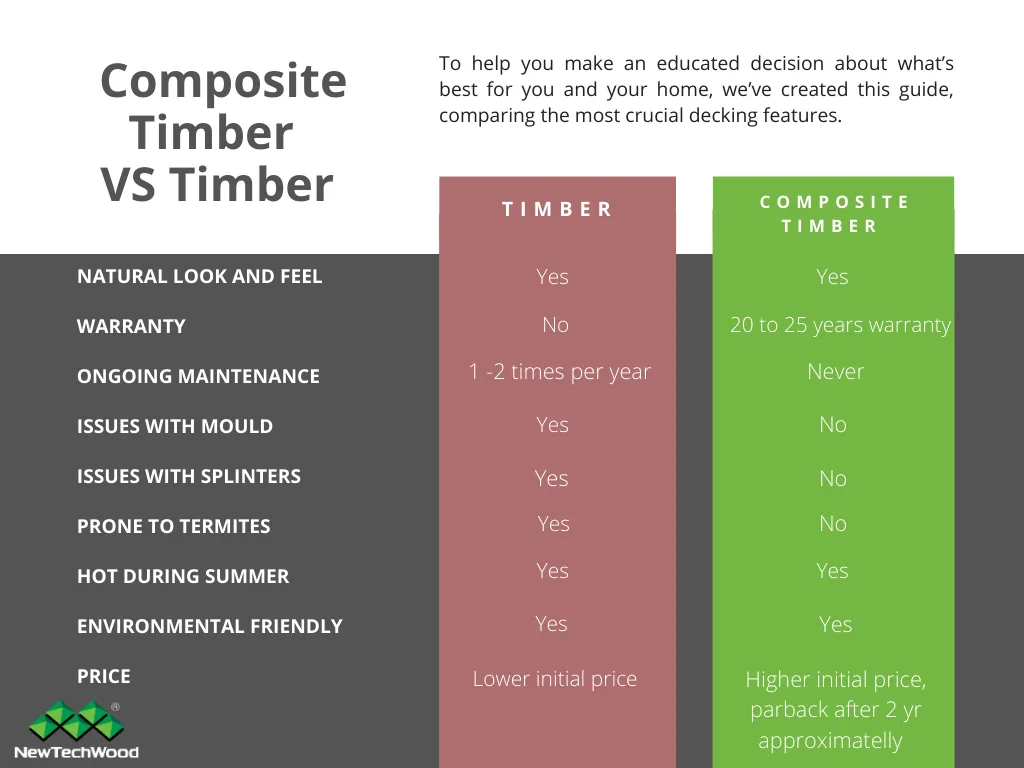
Price
When comparing between the two, look beyond the initial invoice to calculate the total lifetime cost of ownership to get a true comparison of value.
Up-Front Price
If you’re asking “is composite decking more expensive than wood?”, the short answer is yes, especially regarding the initial purchase. Raw timber (particularly softwoods or standard treated pine) commands a lower price per metre than premium composite boards.
Winner: Natural timber (raw timber carries a lower initial materials purchase per metre).
Long-Term Cost
While timber seems to be cheaper initially, the ongoing maintenance costs quickly add up. When you tally the expense of deck cleaners, stains, brushes and sanding equipment (or professional servicing every 12 to 18 months), a natural timber deck becomes significantly more expensive over a 5 to 10-year period. Composite decking doesn’t need any ongoing oiling or staining, letting the price difference pay for itself.
Winner: Composite decking (zero ongoing expenditure on oils, stains or sanding tools).
Value For Money
Value for money comes down to total return on investment over the deck’s lifespan. While timber steadily degrades and demands continuous spend on upkeep, composite decking maintains its structural integrity and finishes with zero maintenance. For homeowners planning to stay in their home long-term, eliminating ongoing maintenance expenses make composite the more economical choice over time. Composite decking generally delivers favourable return on investment when it comes time to sell as well.
Winner: Composite decking (zero maintenance and product lifespans deliver a better investment over time).
Value for money
Value for money comes down to total return on investment over the deck’s lifespan. While timber steadily degrades and demands continuous spend on upkeep, composite decking maintains its structural integrity and finishes with zero maintenance. For homeowners planning to stay in their home long-term, eliminating ongoing maintenance expenses make composite the more economical choice over time. Composite decking generally delivers favourable return on investment when it comes time to sell as well.
Winner: Composite decking (zero maintenance and product lifespans deliver a better investment over time).
Installation and Workability
Both materials can be cut and installed using standard woodworking tools, but their handling characteristics differ.
Weight
Because composite boards consist of high-density plastic and compacted timber fibres, they’re heavier and denser than regular timber boards. This added weight needs proper handling during transport and a strict adherence to the recommended joist span distances during installation.
Winner: Natural timber (lighter board weight makes it easier to manoeuvre on-site).
The Verdict
When comparing composite decking vs wood, timber is still an option for project budgets prioritising the lowest possible upfront cost or maximum heat dispersion in unshaded summer sun. However, for homeowners looking for a luxurious, durable and hassle-free outdoor living area, composite decking is the clear winner.
By eliminating painting, sanding and oiling, fully capped composite decking like NewTechWood delivers a finish that can stand up to weather, termites and rot for decades. It lets you spend your weekends enjoying your outdoor space instead of maintaining it.
Ready to see the difference for yourself? Get in touch with NewTechWood today.